

To sell your product in the market, you need to understand the market, your target customer and your competitor. To do so, you are going to need the best tools for market research.
Just like the failure of Kodak brand, many products fell flat because of poor marketing research. Whether you are planning to set up E-commerce, B2B , or B2C business, sound market research is the core component of success.
Now, what are the most functional tools for market research? No worries. You have come to the right place. In this article, you will go through the 15 best market research tools for quantitative research.
15 Market Research Tools that Actually Work
People resist changes. Most consumers love to stick with their favorite brands. As a result, when a new product enters the market, it faces enormous challenges to survive from existing competitors.
Here, market research gives an upper hand by reducing the risks of failure. Let’s check out some of the best tools for market research:
Tool Name | Remarkable Insights | Costing |
Ahrefs | In-depth keyword research | Premium |
SEMrush | Technical audit | Premium |
SurveyMonkey | Creating online surveys | Basic plan is free. |
Facebook Audience Insight | Detailed insights about Facebook audience | Free |
Ubersuggest | Precise keyword trends | Premium |
Statista | Analyzing statistical data | Basic plan is free. |
Google Trends | Insights about trending topics, keyword research | Free |
Spyfu | Competitor analysis | Premium |
Answer the Public | Search engines trends, keywords | Freemium |
Think with Google | Google research insights | Free |
SimilarWeb | Competitive benchmarking | Premium |
Tableau | Visual data analytics | Premium |
Qualtrics | Experience management using AI | Premium |
Social Mention | Real-time social media research | Basic plan is free |
Ahrefs
Ahrefs – Ahrefs is one of the best tools for market research that the world’s top marketers from Facebook, LinkedIn, Uber, and eBay trust. Anyone can be an SEO master simply by using its tons of features.
Ahrefs crawls search engines and websites for data, letting you know what people are searching for in your niche product, providing insights for content creation, and assisting you with backlinking.
Key Features
- Site Audit for website optimization
- Keyword research
- Competitor analysis
- Content research
- Rank tracker
Pros
- Helps content creators generate new ideas, optimize their own content and analyze competitors’ content.
- Leverages backlink features with useful websites. Detects broken links.
- Lets you know your competitors’ organic search details.
Cons
- The user interface could be improved.
- Compared to its main competitors Moz and Semrush, it has a lesser link index.
- PPC features can be optimized.
Pricing: Lite plan starts at $99
SEMrush
SEMrush – SEMrush is yet another powerful market research tool that marketers utilize to increase conversion rates. It offers a simple dashboard with helpful analytic features and is excellent for competitor analysis.
SEMrush enables you to examine your competitors’ SEO initiatives, as well as those of everyone else, and do crucial analyses using that data. This tool intends to increase online exposure and produce marketing insights by featuring services like SEO, keyword research, PPC, and content marketing.
Key Features
- Offers tools such as on-page SEO, local SEO, keyword research.
- Efficiently manages and organizes organic research.
- Enables your competitors’ demography to study.
- Offers content creation, sharing, optimization and marketing features.
- Compatible with popular Google Apps and other social apps.
- In-depth Traffic, and backlink analysis.
Pros
- SEMrush has the largest keyword database.
- Detailed metrics help you build backlinks and analyze keywords.
- Offers extensive suggestions on how to optimize the site via technical audit.
- A good value for the money given the wide range of features it offers (including SEO and content marketing).
Cons
- Limited to Google’s data only.
- Data from traffic analytics might be inaccurate sometimes.
Pricing: Packages start at $119.95 per month.
SurveyMonkey
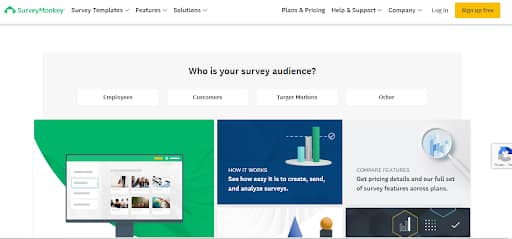
SurveyMonkey – the term “market research” is incomplete these days without mentioning SurveyMonkey. Over 20 million questions are answered daily using this app due to its flexibility in creating and analyzing surveys.
This tool will help you collect responses from your target audience. While data sources provide you with a broad overview of your target audience, SurveyMonkey can assist you in getting more specific customer insights.
Key Features
- Professionally constructed question bank with precise questions.
- Offers expert feedback on survey drafts using AI-powered analysis.
- Customized survey techniques, e.g., branching, and skip logic.
- Team Collab Feature.
Pros
- User-friendly design to conduct surveys.
- A vast collection of templates.
- Accurately summarizes the revised benchmark data.
Cons
- Data representation can be improved using an improved analytical dashboard.
Pricing: Basic plan is free.
Facebook Audience Insight
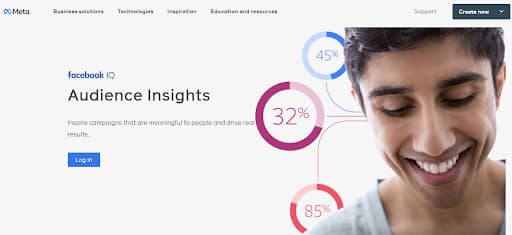
Facebook Audience Insight – With around 2.934 Billion monthly active users, Facebook is undoubtedly one of the biggest online marketplaces. Facebook Audience Insight is known as the best tools for market research for Facebook marketers because of its unparalleled insights.
This free app shares insights about post-performance, page health, monetization of your content, retargeting existing customers, and more. If you are having trouble starting, it has two free courses to help you out:
Key Features
- Audience Insights
- Demographics overview
- Graphical representation of Post engagemnt (like, comment, and share)
- Sorts out customers’ feedback.
- Helps determine the best post type.
Pros
- Provides a large amount of insight.
- User-friendly.
Cons
- Works only for Facebook pages.
Pricing: Free
Ubersuggest
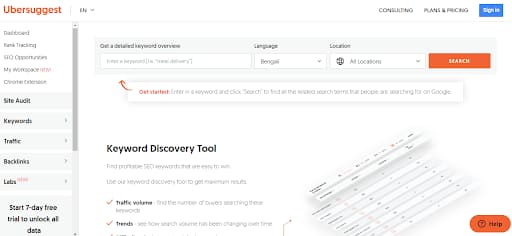
Ubersuggest – Once you enter a domain or keyword, Ubersuggest will assist you in finding the best tactics for the target keyword, keyword ideas, monthly search volumes, and other necessary data.
Neil Patel’s Ubersuggest is an amazing tool for determining the scale of a potential market, determining market competitors, and your chances of ranking in it. You can use this app’s insights to improve your content marketing by responding to product questions from your target market.
Key Features
- Keyword tracking
- Tracks keyword ranking
- Conducts competitive Analysis
- Informs current trends.
- SEO Management
- Monitors backlinking
- Link Management
Pros
- Improves data accuracy by utilizing location-based data.
- The free plan is loaded with features.
Cons
- Missing a number of technical SEO features.
- Restricted to PPC and SEO data only.
Pricing: Starts at $12 USD/month.
Statista
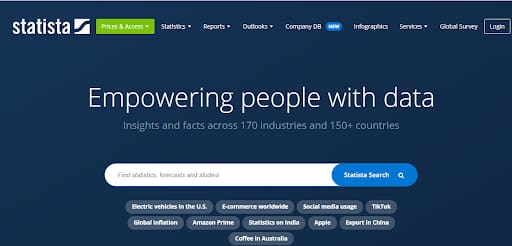
Statista – Statista is a website that visualizes data, making it easy to understand for anyone looking to obtain data from reliable online publications. One of the best features of Statista is that its data gets continuous updates throughout the time period.
Key Features
- Multiple downloadable data formats.
- Infographics.
- Intel on digital trends for prominent brands and businesses
Pros
- An efficient tool for measuring KPI (Key Performance Indicators) to know the consumer market perspective.
- One of the best tools for Analyzing Statistical Data.
- Convenient data search process.
Cons
- Visuals can be improved.
- Features are limited for the free plan.
Pricing: Basic plan is free.
Google Trends
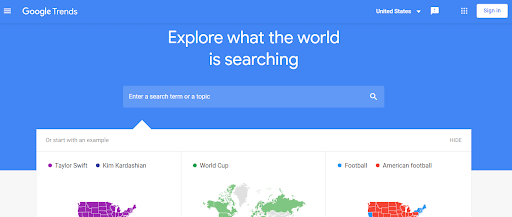
Google Trends – Since 2006, Google Trends has been providing useful insights about trending searches and topics from all over the internet.
For instance, if you search for a term on it, it will show how trendy it has been over time and give it a score out of a hundred.
Key Features
- Displays how frequently your searched phrase has been looked up on the internet over a specific time period.
- Provides a graphic representation of the trend to help visualize the trend more clearly.
- Refines searches through Location filters.
- Exports results in a Google sheet that can be displayed instantly.
Pros
- User friendly.
- Lets you identify if there are any search surges driven by special events.
Cons
- Doesn’t show exact search volumes.
- Might show irrelevant search results.
Pricing: Free
Spyfu
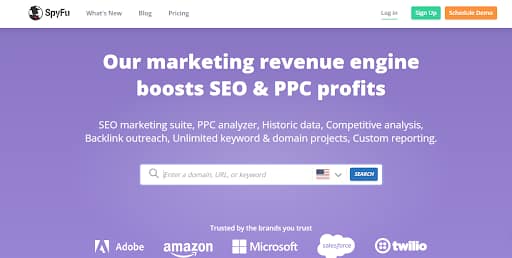
Spyfu – Spyfu allows you to know how your competitors are generating traffic. By simply entering your competitor’s URL, you will get broad details on their traffic stats, the sources of their traffic, and the terms people are using to locate them online.
The best way to serve your target audience is to be aware of how well they are currently being served. It will help you track the market gaps and identify possibilities to improve your product as per the market demand.
Key Features
- Competitors analysis.
- SERP analysis.
- Rank tracking.
- Backlinks builder.
- Rank tracking.
Pros
- Facilitates domain search.
- Offers monitoring features.
- Offer smart suggestions.
Cons
- Might provide inaccurate PPC metrics sometimes.
- Provides keywords from selected domains only.
- Bit costly
Pricing: Basic plan starts at $39/month
Answer the Public

Answer the Public – is a free tool that provides “Raw Search Insights, Direct From The Minds Of Customers.” Just like their motto, they monitor the autocomplete data of search engines, then instantly generate all relevant phrases and queries around your keyword.
You can easily attract your target audience by covering all these searched subjects in your content. Once they visit your website, you can convert them to leads by following your preferred marketing strategy.
Key Features
- Informs you about public searches.
- Sends weekly emails about changes in the search pattern.
- Organizes research using folders.
- Provides context for each search.
Pros
- Boosts the efficiency of your content creation.
- Up-to-date databases help in understanding current topics and trends.
Cons
- Might give relevant search results sometimes.
- Extracting keywords as per niche markets might be difficult.
Pricing: Freemium (Free features + Premium features)
Think with Google
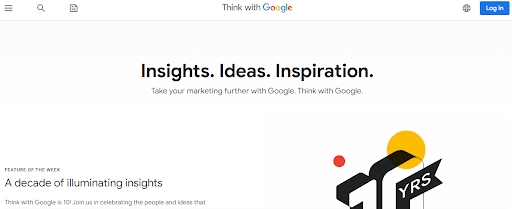
Think with Google – A freely accessible library of data gathered from Google’s own and other research. It is considered one of the best tools for market research because it contains tools, consumer data, market strategies, information about marketing’s current trends and future.
Key Features
- Performs a site audit to provide personalized recommendations on how to improve site speed, UX, and other factors of your domain.
- Allows you to look for trends and useful consumer insights for specific places.
- Utilize new technology to prepare your marketing plans for the future.
- Use a quick test to compare your website to industry benchmarks.
Pros
- One of the best market research tools
- Emphasizes current trends.
Cons
- Dedicated to marketing studies only.
Pricing: Free
Google Keyword Tool
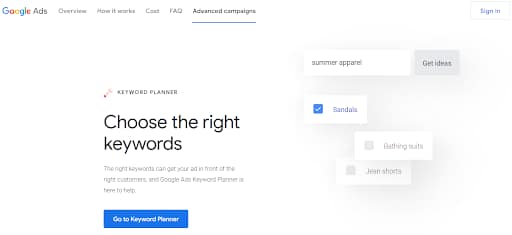
Google Keyword Tool – This highly advanced market research and analysis tool provides a peek into consumers’ internet search habits. With a free Google Adword account, you can get access to useful information on Google searches that your target audience is looking for.
Key Features
- Keyword search feature focused on Location and language.
- Filters search engine results based on users’ preferred devices.
- Helps to know about recent marketing trends via insights.
- Locates potential keywords to contribute to long-tail efforts in the same niche.
- Assists marketers in developing their content plans and marketing strategies.
Pros
- Displays recommendations for ad groups.
- Shows max CPC and competition for keywords.
- Highlights the connections between various keywords to assist you in finding relevant, targeted keywords.
Cons
- Negative keyword list is unavailable.
- More keyword filters can be added
- Long-term keywords are missing for the majority of the categories.
Pricing: Free
SimilarWeb
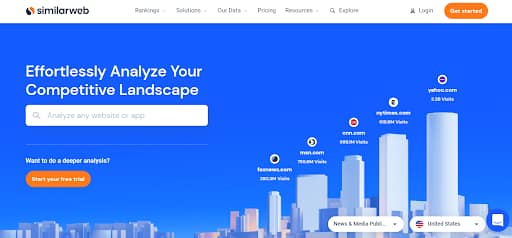
SimilarWeb – SimilarWeb is another recognized and effective tool for market research. It offers extensive information on various industries. You can find out more information about your sector as well as new top websites, top apps, and other useful information. Moreover, It helps you do keyword research to find other related keywords for your niche product.
Key Features
- Keyword research for new keywords.
- Checks the condition of your website by comparing it with industry benchmarks.
- Gives you detail on consumer trends throughout your app, marketplace listings, and website.
- Provides insights about the global market trend, competitors on domain and sub-domain tiers.
- Analyze websites and mobile apps to know their traffic, demographic targeting, competitors, ranking, and other details.
Pros
- User-friendly UI.
- Extension provides instant website performance updates.
Cons
- Data can occasionally fail to deliver actual insights.
Pricing: Freemium (Free features + Premium features)
Tableau
Tableau – This is a visual data analysis tool that helps people understand complex data by simplifying it with visuals. Tableau allows you to filter and analyze data based on a variety of factors, including demographics, geography, and many others.
You can use Tableau to extract data from different sources like Google Analytics, excel sheets, and relational databases. This data can then be combined to produce collective datasets that present a more comprehensive picture of the market.
Key Features
- Data gathering and categorization without programming.
- Intelligent dashboards for in-depth insights.
- Visualize any form of Data.
- Works directly with other market research tools like Salesforce and Qualtrics.
Pros
- Best-known Data Visualization tool.
- Simplified Data Analysis Process.
- Mobile optimized.
Cons
- Doesn’t automatically source data.
- Might take a while to upload longer data sources.
Pricing: $70user/month (Billed annually)
Qualtrics
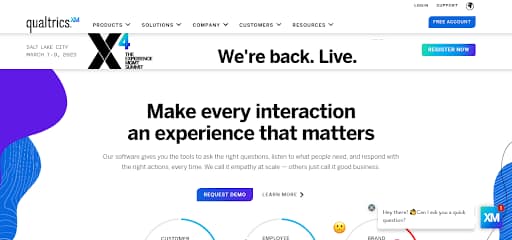
Qualtrics – Qualtrics is an all-rounder platform, where you can monitor brand recognition, perform market research campaigns, customize products and services, and measure consumer feedback.
You can learn in-depth insights about market research by using this platform. Its cutting-edge statistical tactics enable you to learn about your target audience. It’s so time-efficient that it completes all of the tasks it does in a small amount of time compared to other conventional processes.
Key Features
- Offers a targeting feature for your potential customers.
- Provides 27+ channels for rollout, e.g., websites, emails, QR codes, and more.
- The iQ™ analysis engine automatically extracts data, identifies possibilities, and suggests changes using AI, NPL, and machine learning.
- Analysis feature for market trends.
Pros
- Aquire and maintain market research data for you using the XM feature.
- Flexible survey making.
- Well-organized data reporting.
- Full compatible with all screen sizes.
Cons
- Dashboard can be tweaked.
- Directories may take some time to update the contact information.
Pricing: Qualtrics doesn’t disclose pricing openly. Contact them here to request a price.
Social Mention
Social Mention – A specialized, real-time search engine with an emphasis on social media mentions. One of the best tools for market research to learn more about what your current and potential customers are discussing.
Sites like Facebook, Google, and Twitter are just a few of the more than 100 social media platforms that Social Mention combs through to look for mentions of your company, your competitors, or any other keywords you provide.
All you have to do is type in a search term, hashtag, or website URL, and you will get to see all mentions across social media for that particular brand or product.
Key Features
- Shows how frequently your keyword appears across all social media channels.
- Complete competitor research
- Supports integration with other social media platforms for more precise data
- Analysis feature for sentiment, differentiates between positive and negative sentiments.
Pros
- Assembles data from across the internet into a single dashboard for real-time tracking.
- Helps identify the perfect influencers.
- Simplifies the process of analyzing the domains where your targeted audience is headed.
Cons
- UI is not convenient for beginners.
Pricing: Basic plan is free.
Our Recommendation
Now that you’ve learned about all of these useful apps, you’re probably wondering which one to use, right? I know, it’s hard to choose one from them as all of these tools provide tons of useful features.
Every user is different, and so are their goals. I personally recommend Ahref. Its user-friendly approach and the fact that all features are under one roof explain why it is favored by tech giants’ marketers. However, it completely depends on you.
To Wrap Up
Market research is an irreplaceable element of a business structure. Regardless of business type, market research will always be known as the most efficient method of uncovering insights and reducing risk.
I believe these best tools for market research will help you in your quest to thrive. Just stay up to date with the market trend and implement the tactics that minimize the cost and maximize the profit.